Zoom's Realtime Media Streams delivers meeting audio, video and transcripts over WebSockets without a bot in the room. Here's how RTMS actually compares to meeting bots — and why you'll likely run both.
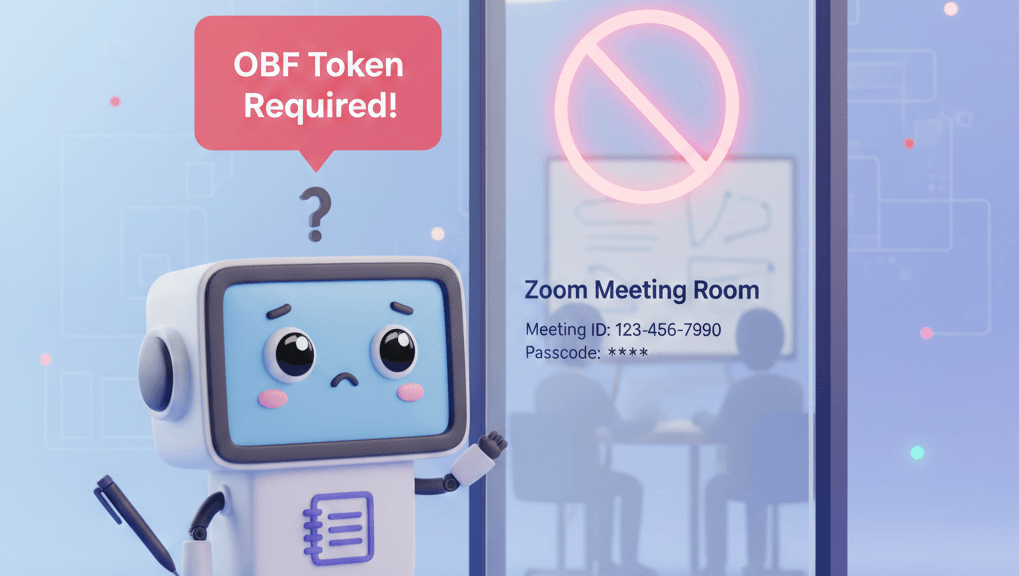
Zoom has spent 2026 reshaping how developers access meeting data. First came the OBF token requirement in March, tightening how bots join external meetings. Then Zoom pushed Realtime Media Streams (RTMS): a data pipeline that streams live audio, video, per-participant media and transcripts from Zoom meetings over secure WebSockets — with no bot participant in the room at all.
Zoom's pitch is explicit: "no more suspicious, confusing bots joining your meetings." So is the bot model dead? Not close — but the honest answer is more interesting than either extreme.
What RTMS actually is
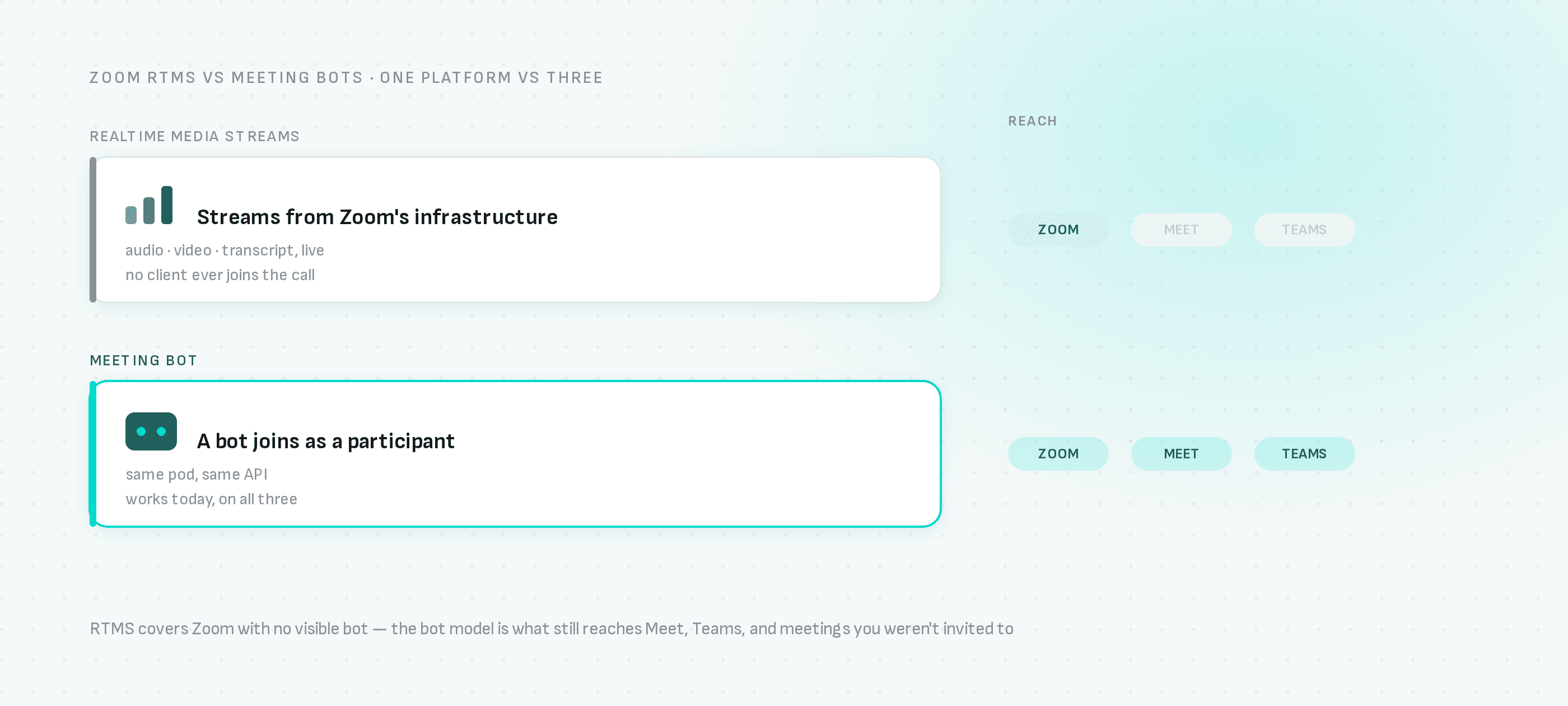
RTMS gives apps direct access to a Zoom meeting's media as structured streams: per-participant audio and video, transcript data and participant events, delivered over WebSockets while the meeting runs. There's no automated client joining the call — the data comes from Zoom's infrastructure itself.
That's genuinely better than a bot in several ways:
- No visible participant: nothing to admit from a waiting room, nothing occupying a gallery tile — though Zoom still shows a standard "this meeting's content is being shared with one or more apps" disclosure and may surface App Activity Notifications while an app accesses the meeting
- Per-participant streams: cleaner separation than diarizing a mixed recording
- No join reliability problem: there's no client that can fail to join
What RTMS doesn't solve
- Zoom's specific no-participant model is unmatched. Google Meet has a Media API in Developer Preview and Microsoft Teams has a Real-Time Media Platform — both give raw stream access, but both still require a bot-like client to join the call; Microsoft explicitly steers AI-agent use cases away from it. Zoom's RTMS is the only one of the three that hands you streams with nothing joining at all. A product built purely on participant-free capture covers one platform today; a meeting bot API covers all three with one integration.
- It requires app setup on the Zoom side. RTMS runs through a Zoom app with the appropriate scopes and account-level enablement — the kind of per-tenant configuration the bot-as-guest model avoids.
- Recording artifacts are your job. RTMS hands you streams; assembling recordings, transcripts and searchable archives from them is infrastructure you build and operate.
- Meetings you're invited to. The bot model's core use case — recording meetings your users attend across other organizations — depends on the host's platform and settings either way. On Zoom, this is also where implementations diverge: bots built on Zoom's Meeting SDK need OBF authorization for external meetings, with the authorizing user required to stay present. How exposed a given vendor is to that constraint depends on how their bot actually joins the call — and whether your product has to build a Zoom consent screen at all is worth asking about directly, since not every implementation requires it.
The realistic architecture: both
The teams shipping meeting products in 2026 are converging on a hybrid: RTMS where it's available and enabled, bots everywhere else. That's also our position at Meeting BaaS — the same API that gives you bots for Zoom, Google Meet and Microsoft Teams today is where RTMS-based capture slots in as Zoom rolls it out, without changing your integration.
If you want live meeting data right now, across all three platforms, real-time streaming already delivers live audio and transcripts over WebSockets from the bot itself — the same shape of data RTMS promises, minus the single-platform constraint.
What to do today
- Building Zoom-only, enterprise, with tenant control? Watch RTMS closely; it's the sanctioned path and Zoom is investing in it.
- Building cross-platform? The bot model stays your primary integration — one API, three platforms, no per-tenant Zoom app deployment.
- Already running bots on Zoom? Make sure you're OBF-ready — that's the change with a hard deadline that already passed (March 2, 2026).
Next steps
- Meeting bot API — cross-platform capture today
- Real-time meeting transcription & streaming — live WebSocket data on all three platforms
- Zoom's OBF token requirement explained
- Zoom RTMS documentation